
The Power of Protest: Utahns would travel 6 hours to protest a cause they believe in, reveals survey.
It might seem like, in 2018, there’s never been more for Americans to protest about. The current political climate, the advent of the #metoo movement, ongoing inequality… However, it’s still all too easy for people to say they’re against something, but actually do nothing about it, preferring to watch others on the news from the comfort of their living rooms. But surely we Americans are more switched on and galvanised than that? We have a long and glorious tradition of protesting which began, after all, with the Boston Tea Party.
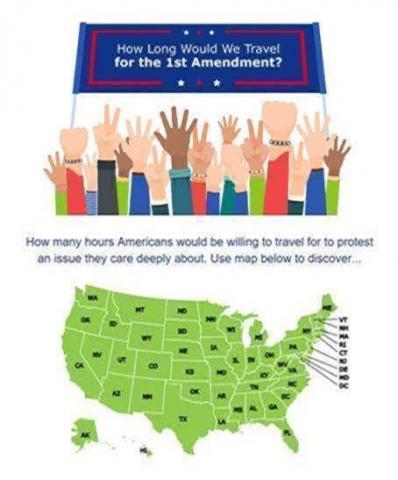
So to find out how willing we are to protest, custom sign designers ShieldCo, surveyed 3,000 adults to find out how strongly they feel about it. The first result found that, on average, Utahns would be prepared to travel a significant 6.1 hours away from their homes to take part in a protest for a cause they really believe in. In fact, the good people of The Beehive State would be prepared to travel considerably more than most other Americans (5.5 hours being the national average).
The most avid protesters, however, were found to be in Wyoming; people from this vast state would gladly get in their cars and drive 18.3 hours – that’s nearly a whole day, and around three times the time it would take to drive across the state itself – to wave a sign or banner for a good cause. Those not so willing to go the distance, however, were those from Rhode Island; to them, 1 hour of travel time seems like enough – perhaps because their state is a little smaller than most!
To find out how your state compares, check out this interactive map: https://www.shieldcoart.com/custom-metal-business-signage-blog/2018/8/31/travelling-for-a-cause
When asked what issues respondents would be most likely to protest about this year, five topics in particular stood out: Politics or political figures; gender equality; racial equality; the environment and economic/labor rights.
Examples of these types of protests include last year’s march of 200,000 in Washington DC, to stand up for gender equality; the protest extended internationally, with sister marches in 60 countries on every continent, including Antarctica.
Racial equality is still a huge issue in America, one which people today very much believe is still worth fighting for. Ever since Martin Luther King, Jr, made his iconic, ‘I have a dream’ speech in 1963, Americans have had to keep protesting, and in 2013, the Black Lives Matter movement was founded.
And in the aftermath of events such as the U.S. pulling out of the Paris Climate Agreement in 2017, which resulted in thousands of demonstrators taking to the streets in Washington, environmental issues are also high on people’s list as a concern.
Last, but not least, economic/labor rights are on the protest agenda; as far back as 1886, known as The Great Southwest Railroad Strike, some 200,000 strikers protested what they claimed to be unsafe conditions, long hours and poor pay. Unfortunately, the railroad companies eventually prevailed by hiring non-union workers. And earlier this year, tens of thousands of teachers protested across the country, demanding higher pay and higher school funding.
The survey also found that nearly half of respondents (49%) were more likely to protest an issue in 2018 than any other year, and that 73% of us believe that protesting does actually work, and is not a pointless exercise – although there are some leading academics who believe marches and protests don’t actually offer a solution to the problems.
The survey also found that 60.5% of us aren’t aware of protesting laws, which can differ by state, and which might mean you need a permit before you can do so; nearly a quarter of us don’t actually know which amendment of the constitution (it’s the first!) allows freedom of assembly; and, perhaps worryingly, that 63.5% of people would be put off attending a protest by bad weather!
‘Despite there being so many protests across our nation for varied causes, I think all Americans can agree that, whatever your point of view, we should never take our 1st Amendment freedoms for granted,’ says Luke Markey from ShieldCo.